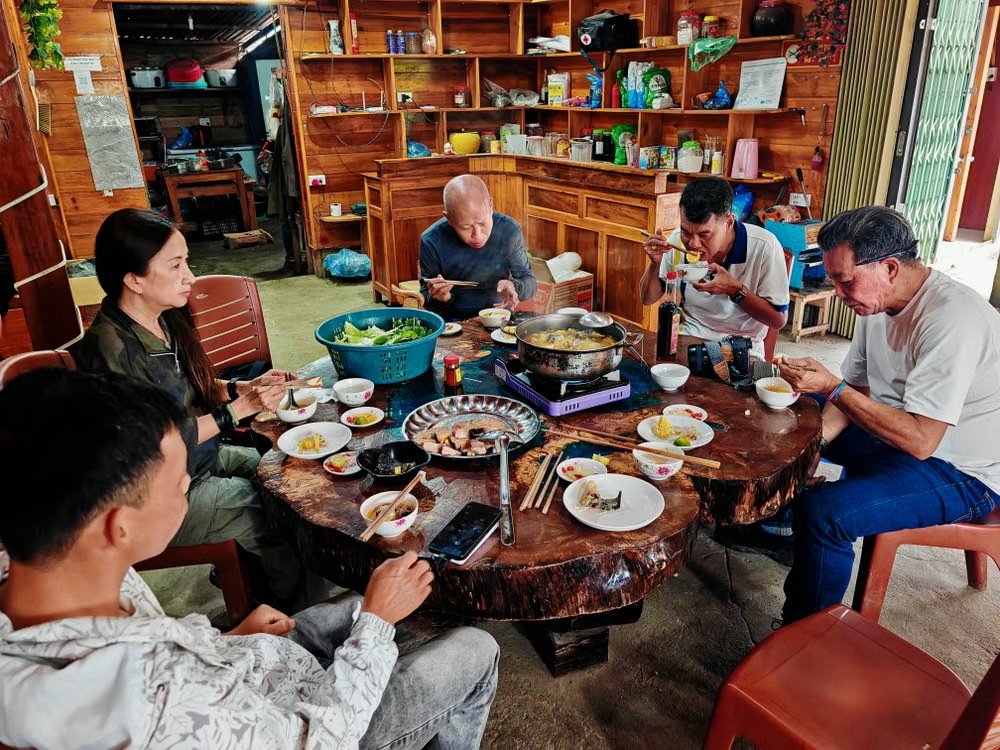
Every Sunday, the Marens ate at the same table.
Nobody remembered buying it.
Grandmother said it had belonged to her mother.
Her mother had apparently said the same thing.
The table had eight chairs, and each chair belonged to a particular kind of person.
The chair nearest the kitchen belonged to whoever looked after everybody.
The chair facing the door belonged to whoever earned the most money.
The chair beside the window belonged to the difficult one.
The small chair near the cabinet belonged to whoever was still treated like a child.
There was a chair for the successful one.
A chair for the disappointing one.
A chair for the person whose problems were never mentioned.
And at the end of the table stood the oldest chair.
It belonged to whoever was expected to keep the family together.
Nobody discussed the rules.
Children learned them by watching where adults sat.
When Mara was young, she occupied the small chair.
At sixteen, she tried sitting beside the window.
Her father laughed.
“Wrong chair.”
Everybody laughed with him.
Mara returned to her place.
Years passed.
People changed.
The chairs did not.
Mara’s brother, Tomas, became a teacher and loved his work, but because his younger cousin earned more money, Tomas was never offered the chair facing the door.
Their aunt Celia had spent twenty years being called difficult because once, at twenty three, she had refused to marry a man the family liked.
She remained beside the window.
Grandmother became tired.
Still, every Sunday she sat nearest the kitchen.
Then one Sunday Mara arrived early.
Nobody else was there.
She looked at the table.
Eight chairs waited obediently.
For the first time, they seemed absurd.
Mara carried every chair into the garden.
When the family arrived, they found the table standing alone.
Grandmother stared at it.
“Where are the chairs?”
“Outside.”
“Why?”
“I thought we could choose.”
Nobody moved.
Her father became angry first.
“We already have places.”
“That is the problem.”
He walked into the garden and retrieved his chair.
Then Grandmother retrieved hers.
Soon everyone was carrying the old arrangement back into the room.
Everyone except Celia.
She remained outside.
Mara joined her.
They sat on the grass.
After several minutes, Tomas came out carrying a plate.
Then the youngest cousin.
Then Grandmother appeared at the doorway.
She looked back at the chair beside the kitchen.
She had occupied it for fifty eight years.
Slowly, she walked outside.
Nobody spoke.
Grandmother lowered herself onto the grass.
“I hated that chair,” she said.
Celia began laughing.
Then Mara.
Then Tomas.
Eventually even Grandmother laughed.
Inside, the table remained perfectly arranged.
Every inherited identity was waiting.
Nobody returned to it.
The following Sunday, Mara arrived carrying a folding chair.
Tomas brought a cushion.
Celia brought a bench she had painted blue.
Grandmother brought nothing.
She said she wanted to sit somewhere that had not already decided who she was.
Fiction note
The Family That Assigned Everyone a Chair is an original Arise Stories fictional fable. The Maren family and its members are fictional.